What Is Line Editing?
Whether you’re writing your first novel, a nonfiction book, or a memoir, completing your manuscript is only the beginning. Before your work is ready for publication, it needs careful editing not just for grammar, but for clarity, rhythm, tone, and readability.
This is where line editing plays a critical role.
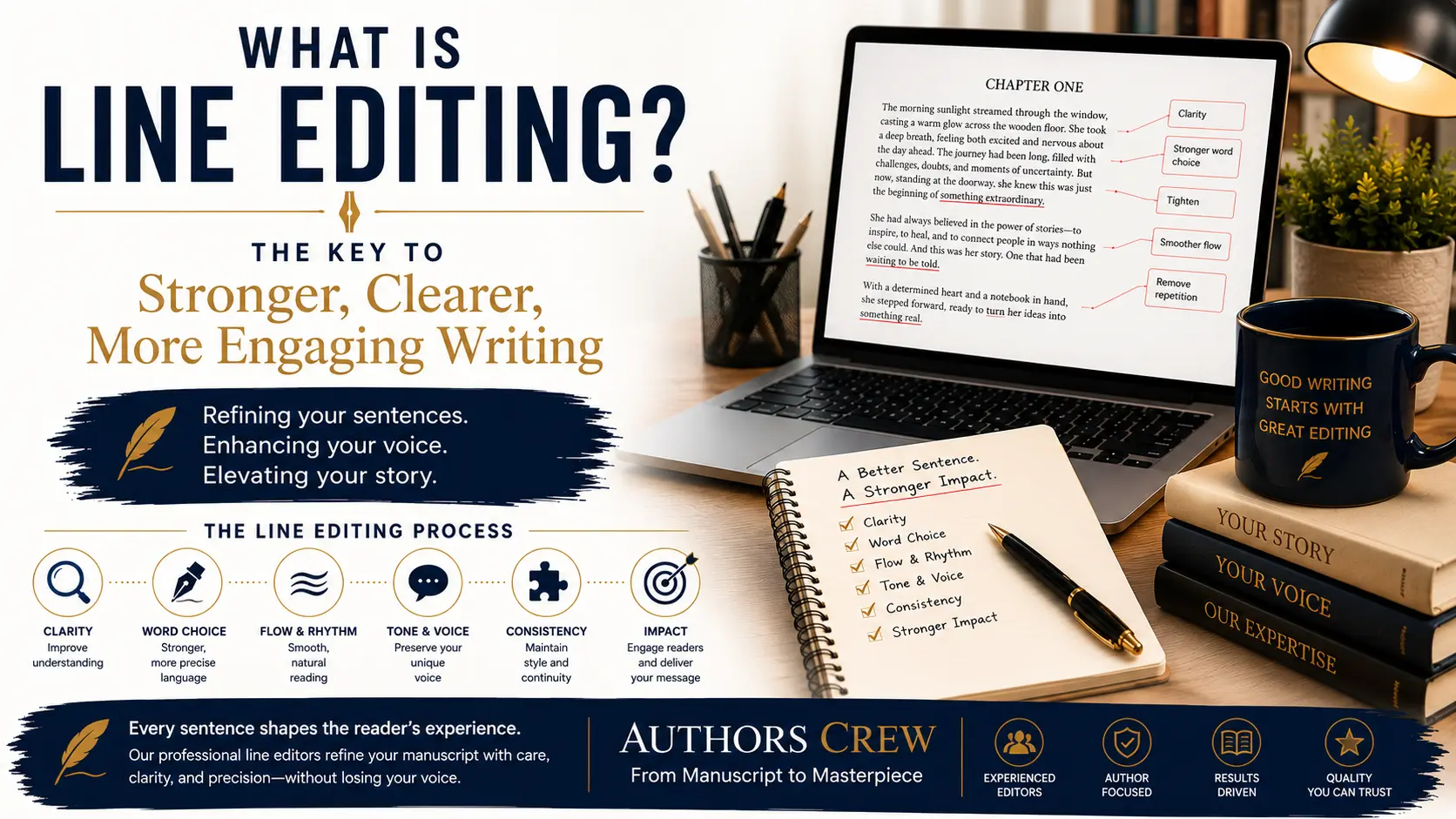
Professional line editing transforms good writing into compelling writing by refining every sentence without changing your unique voice. Rather than focusing solely on grammar or spelling, a line editor improves how your ideas flow, how your words connect with readers, and how effectively your message is delivered.
According to publishing experts, line editing is a sentence-level editorial process that strengthens style, clarity, pacing, and consistency after the manuscript’s overall structure has been finalized.
Quick Answer: What Is Line Editing?
Line editing is the process of improving a manuscript one sentence at a time by enhancing clarity, word choice, tone, flow, rhythm, and readability while preserving the author’s voice. It focuses on how the writing communicates rather than simply correcting grammar or punctuation.
Unlike copy editing, which corrects technical errors, line editing refines the quality of the prose itself, making it more engaging, concise, and impactful.
Why Is Line Editing Important?
Many writers believe that once they’ve corrected grammar mistakes, their manuscript is ready for publication. In reality, grammatical accuracy is only one part of excellent writing.
Readers don’t remember flawless punctuation. They remember writing that flows naturally, evokes emotion, and keeps them turning pages.
Line editing helps achieve this by improving the reading experience. It removes awkward phrasing, strengthens weak sentences, eliminates repetition, and ensures every paragraph contributes to the overall narrative.
A professionally line-edited manuscript often feels smoother and more immersive because every sentence has been evaluated for its effectiveness not just its correctness.
For authors pursuing traditional publishing, self-publishing, or professional business writing, line editing significantly improves readability and overall manuscript quality before the copyediting stage begins.
What Does a Professional Line Editor Do?
A professional line editor examines your manuscript sentence by sentence and paragraph by paragraph, asking one essential question:
“Can this idea be communicated more clearly, naturally, and effectively?”
Rather than rewriting your book in their own style, a skilled line editor strengthens your existing voice while improving readability.
A Line Editor Focuses On
Clarity
Complex or confusing sentences are simplified without losing meaning.
- Instead of: She began walking in the direction of the house because she had realized that perhaps it would be a better decision to leave.
- A line editor might suggest: Realizing it was time to leave, she walked toward the house.
The meaning remains unchanged, but the sentence becomes more direct and engaging.
Word Choice
Professional editors replace vague or repetitive language with stronger, more precise alternatives.
- Instead of: The meeting was very important.
- A stronger version becomes: The meeting proved pivotal.
Choosing precise language increases the impact of every sentence.
Sentence Variety
Paragraphs filled with sentences of identical length can become monotonous.
Line editors vary sentence structure by combining short, medium, and longer sentences to create a natural rhythm that keeps readers engaged.
This subtle improvement enhances pacing and readability throughout the manuscript.
Flow and Transitions
Good writing moves effortlessly from one idea to the next.
Line editors smooth abrupt transitions, improve paragraph organization, and ensure each sentence logically supports the next.
When transitions are effective, readers stay immersed in the content without having to pause or reread.
Tone and Voice
One of the biggest misconceptions about line editing is that editors rewrite a manuscript to sound like themselves.
The opposite is true.
Professional line editors work to preserve the author’s distinctive voice while removing distractions that weaken it. Whether your style is conversational, literary, humorous, or academic, line editing strengthens consistency without changing your identity as a writer.
What Does Line Editing Improve?
Professional line editing typically addresses:
- Clarity and readability
- Sentence structure
- Word choice
- Tone and consistency
- Dialogue refinement
- Paragraph flow
- Pacing
- Repetition
- Redundancy
- Passive voice where appropriate
- Stronger transitions
- Concise writing
- Emotional impact
These improvements help readers focus on your message instead of being distracted by awkward or ineffective prose.
Signs Your Manuscript Needs Line Editing
Many authors wonder whether they need a line edit or if copy editing alone is enough.
Your manuscript likely needs line editing if readers mention any of the following:
- Some sentences feel awkward.
- The writing sounds repetitive.
- Dialogue feels unnatural.
- Paragraphs seem too long or difficult to follow.
- The pacing slows in certain chapters.
- Your ideas are clear, but the writing lacks impact.
- Beta readers lose interest despite liking the story.
These issues often indicate stylistic weaknesses rather than grammatical ones.
Before and After: A Realistic Example
Before Line Editing
The storm was very bad, and everyone inside the cabin felt scared because the loud wind continued making frightening sounds all throughout the night.
After Line Editing
The storm battered the cabin through the night, and every gust of wind deepened the growing fear inside.
Notice that the revised version doesn’t simply shorten the sentence—it strengthens imagery, rhythm, and emotional impact while preserving the original meaning.
Where Does Line Editing Fit in the Publishing Process?
Professional publishers like Authors Crew generally follow a structured editing workflow:
- Developmental Editing
- Line Editing
- Copy Editing
- Proofreading
Each stage builds upon the previous one.
Publishing experts consistently recommend completing structural revisions before line editing, followed by copyediting for technical correctness and proofreading as the final quality check before publication.
Line Editing vs. Developmental Editing
One of the most common questions authors ask is whether they need developmental editing or line editing. While both improve your manuscript, they focus on different aspects of the writing process.
| Developmental Editing | Line Editing |
| Focuses on the big picture | Focuses on sentence-level writing |
| Reviews plot, structure, pacing, and organization | Improves clarity, flow, rhythm, and style |
| Identifies gaps in logic or storytelling | Refines word choice and sentence construction |
| Happens early in the editing process | Takes place after structural revisions |
Think of developmental editing as designing the blueprint of a house, while line editing perfects every room inside it. If the structure of your manuscript isn’t finalized, line editing should wait until major revisions are complete. Publishing professionals generally recommend completing developmental edits before moving on to line editing.
Line Editing vs. Copy Editing
Although the terms are often used interchangeably, line editing and copy editing serve different purposes.
Line Editing
A line editor focuses on how your writing sounds and feels to readers by improving:
- Clarity
- Flow
- Style
- Tone
- Rhythm
- Word choice
- Sentence variety
- Emotional impact
Copy Editing
A copy editor focuses on technical accuracy by correcting:
- Grammar
- Spelling
- Punctuation
- Capitalization
- Hyphenation
- Style guide consistency
- Internal consistency
- Minor factual inconsistencies
According to The Chicago Manual of Style, copyediting is generally the final editorial stage before typesetting, whereas line editing concentrates on refining the prose itself.
Line Editing vs. Proofreading
Proofreading is often misunderstood as editing, but it is actually the final quality check before publication.
| Line Editing | Proofreading |
| Improves writing quality | Finds remaining errors |
| May rewrite sentences | Does not rewrite content |
| Strengthens readability | Corrects typos and formatting issues |
| Happens before copy editing or alongside it, depending on workflow | Happens after editing is complete |
A proofreader assumes that the manuscript has already been professionally edited. Their goal is simply to catch any remaining mistakes before printing or publishing.
How to Line Edit Your Own Manuscript
Hiring a professional editor is ideal, but every writer should learn basic line editing techniques. Self-editing improves your manuscript before it reaches an editor, making the editing process more efficient.
1. Let Your Manuscript Rest
Avoid editing immediately after finishing your draft.
Set it aside for a few days or longer if possible. Returning with fresh eyes makes awkward phrasing, repetition, and inconsistencies easier to spot.
2. Read Your Writing Aloud
Reading aloud helps identify:
- Unnatural dialogue
- Long sentences
- Repetitive wording
- Missing transitions
- Poor rhythm
If you stumble while reading, your readers probably will too.
3. Remove Unnecessary Words
Strong writing is concise.
Replace weak phrases such as:
- very good → excellent
- in order to → to
- due to the fact that → because
- at this point in time → now
Eliminating unnecessary words improves readability without sacrificing meaning.
4. Replace Weak Verbs
Compare these examples:
Weak
She was walking toward the door.
Stronger
She hurried toward the door.
Specific verbs create stronger imagery and reduce reliance on adverbs.
5. Eliminate Repetition
Watch for repeated:
- Words
- Sentence openings
- Ideas
- Descriptions
- Dialogue tags
Readers notice repetition more quickly than writers do.
6. Check Paragraph Flow
Each paragraph should develop one clear idea and transition naturally into the next.
Ask yourself:
- Does this paragraph support the previous one?
- Is the transition smooth?
- Could these ideas be combined?
Good flow keeps readers engaged from beginning to end.
Common Line Editing Mistakes to Avoid
Even experienced writers make stylistic mistakes that weaken their manuscripts.
Avoid these common issues:
- Overusing passive voice
- Writing overly long sentences
- Relying on filler words
- Excessive adverbs
- Repeating the same descriptive words
- Explaining what readers already understand
- Switching tone unexpectedly
- Using inconsistent point of view
- Writing dialogue that sounds unnatural
A skilled line editor identifies these problems while preserving the author’s intent and voice.
Should You Hire a Professional Line Editor?
If your goal is professional publication, hiring an experienced line editor is often a worthwhile investment.
Professional editors bring an objective perspective that is difficult to achieve when reviewing your own work. They can identify issues with clarity, pacing, repetition, and style that authors may overlook after multiple revisions.
You should consider hiring a line editor if:
- You’re preparing a manuscript for publication.
- Beta readers say the writing feels awkward or inconsistent.
- You want your prose to be more engaging.
- You’re self-publishing and want a polished final product.
- You’re submitting your work to literary agents or publishers.
A professional line edit can elevate a manuscript from technically correct to genuinely compelling.
Frequently Asked Questions
What is the purpose of line editing?
The purpose of line editing is to improve the clarity, style, rhythm, and readability of a manuscript while preserving the author’s voice. It enhances how the writing communicates with readers rather than simply correcting grammar.
Is line editing the same as copy editing?
No. Line editing focuses on sentence-level quality, style, and flow, while copy editing concentrates on grammar, punctuation, spelling, and consistency.
Does every manuscript need line editing?
Most professionally published books benefit from line editing. It strengthens prose, improves readability, and prepares the manuscript for copyediting and proofreading.
Can AI replace a professional line editor?
AI tools can identify grammar errors, suggest wording improvements, and flag repetitive language. However, they cannot consistently evaluate narrative voice, pacing, emotional impact, or stylistic nuance. Human editors remain essential for refining manuscripts intended for publication.
How long does line editing take?
The timeline depends on the manuscript’s length, complexity, and condition. A full-length book often requires several days to several weeks of detailed editorial work.
What comes after line editing?
After line editing, the manuscript typically moves to copyediting, followed by proofreading before publication. This sequence helps ensure both stylistic quality and technical accuracy.
Final Thoughts
Line editing is more than correcting sentences it is the craft of making your writing clear, engaging, and memorable. By refining language, improving flow, and preserving your unique voice, line editing bridges the gap between a finished draft and a publication-ready manuscript.
Whether you’re writing fiction, nonfiction, memoir, or business content, investing time in line editing helps your ideas resonate with readers and strengthens the overall quality of your work. As recognized publishing authorities note, effective editing is a staged process, with line editing serving as a critical step between structural revision and final copyediting.
Partner with Authors Crew and give your manuscript the professional line editing it deserves because every great story should be told with confidence, precision, and impact.